

Astigmatism has picked up a reputation for ruling out contact lenses, and plenty of people accept that without asking. Others tried a pair years ago, found their phone screen still looked smudged, and gave up. Fortunately, contact lens technology has progressed.
Yes, you can wear contact lenses with astigmatism, and there are several lens designs made specifically for eyes shaped like yours. The trick is matching the right lens type to your prescription and getting the fit measured properly during a contact lens exam and fitting.
What Astigmatism Means for Your Vision
Most eyes curve about the same amount in every direction, close to the shape of a basketball. Astigmatism means one direction curves more steeply than another, so light lands in more than one spot inside your eye.
That’s why vision can look soft even when you’re focusing hard. It’s also why you may see extra numbers on your prescription, since astigmatism often shows up alongside nearsightedness or farsightedness.
Signs of Astigmatism You May Notice
Astigmatism tends to show up in small everyday moments rather than all at once. Watch for a few of these:
- Letters and numbers look blurry or slightly doubled
- Headlights stretch into streaks after dark
- Glare bothers you more than it used to
- Your eyes feel tired after a long stretch of reading
- Headaches settle in by evening
Why Regular Contacts Often Fall Short
A regular soft lens carries the same power around its whole surface, which suits an evenly curved eye. Comparing contact lens types shows how much the design matters here.
There’s a second issue. Lenses rotate a little every time you blink, and even slight rotation pulls the correction out of line with your axis. So an ordinary lens might read clear one moment and soft the next.
Contact Lens Options for Astigmatism
There are a few different lens options for people with astigmatism these days.
Soft Toric Lenses
Toric soft lenses are weighted to settle into one position and hold it while you blink. Most sit slightly thicker along the bottom edge, so gravity and your eyelids keep the axis steady.
Daily disposables can suit you if you wear contacts a few times a week, and they help when allergies make reusable lenses uncomfortable. Monthly toric lenses cover a wider prescription range, so they often come up for stronger prescriptions.
Rigid, Hybrid and Scleral Lenses
Firm lenses hold their own shape rather than draping over the eye, so they can correct higher or irregular astigmatism. Hard contact lenses last longer too, though most people need a week or 2 to get used to the feel.
Hybrid lenses put a firm centre inside a soft outer skirt, which can make those first days easier. Scleral lenses are larger and rest on the white of your eye, and many people find them comfortable when dryness or keratoconus is part of the picture.

Lenses for Reading Vision
Close-up print gets harder to read for most people once they reach their 40s, a condition known as presbyopia. Ask about these options:
- Multifocal toric lenses, which cover near and distance vision in one lens
- Monovision, which sets one eye for distance and the other for reading
- Reading glasses worn over your contacts
What Happens During a Contact Lens Fitting
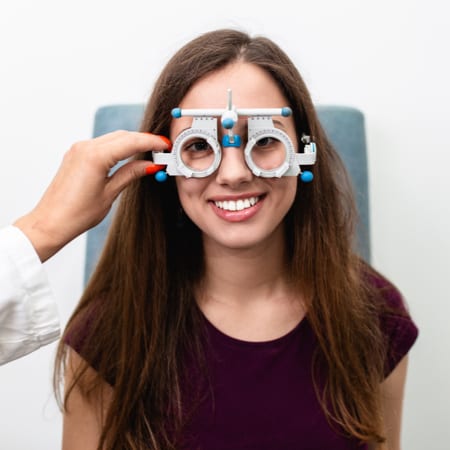
A fitting takes more than a quick prescription handoff, and that extra measuring keeps toric lenses where they should be. Here’s how it goes:
- Your optometrist maps the curve of your cornea and checks the surface your lenses will sit on
- A trial lens goes in and settles while the optometrist watches how far it rotates
- You wear the lenses through a normal week, then come back so the fit can be adjusted
Cost and Candidacy for Toric Lenses
Toric lenses cost more than standard soft lenses because of the design work behind them, and your insurance and payment options can make the numbers clearer before you order a supply.
A strong prescription rarely rules contacts out on its own, so ask rather than assume. And if your eyes run dry, dry eye treatment may come first so lenses feel comfortable from day one.
How to Keep Your Toric Lenses Comfortable
Wash your hands, place the lens, then blink a few times and let it settle before you judge the clarity. Avoid sleeping in your lenses, and keep them out of pools and lakes. Daily contact lens care can keep the surface clean.
If your eyes feel gritty by mid-afternoon, rewetting drops can help, and contact lenses made for dry eyes may hold moisture longer.
When to Call Your Optometrist
Some symptoms are worth a phone call rather than waiting to see what happens:
- Pain, redness, or new sensitivity to light
- Blur that stays after you take the lens out
- A lens that keeps rotating no matter how long it settles
- Discharge or swelling around the eye
Find the Right Contact Lenses for Your Astigmatism
Astigmatism doesn’t have to keep you in glasses full time. The optometrists at Woodstock Vision Care can walk you through which lens design suits your prescription and the way you spend your day. Book your contact lens fitting and discover what clear vision looks like.